

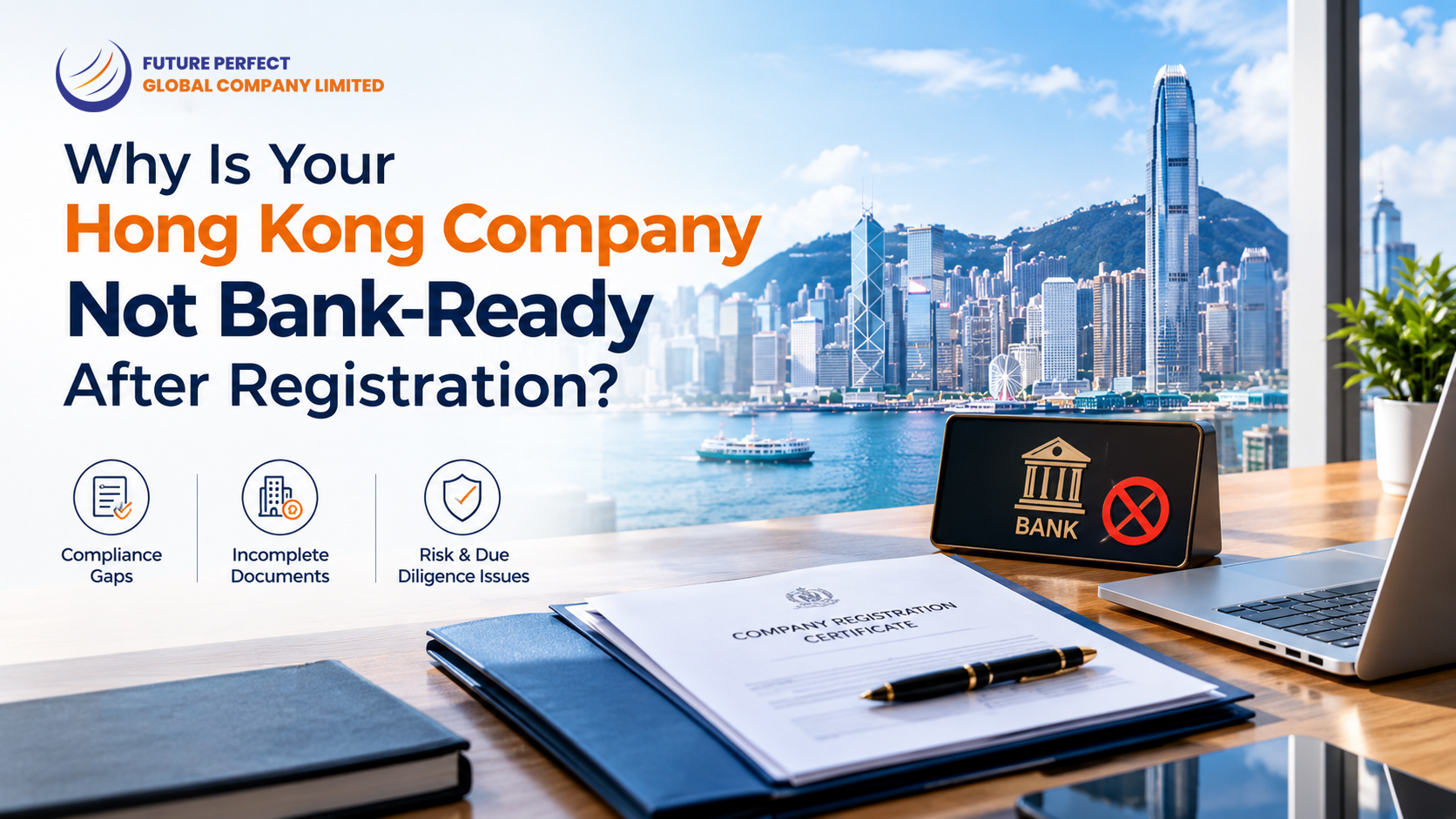
Registering a company in Hong Kong is an important milestone, but it does not automatically mean that a bank will approve a corporate account. Banks need to understand who owns the company, what the business does, where its money comes from and how the proposed account will be used.
For overseas entrepreneurs and newly incorporated businesses, the difference between a registered company and a bank-ready business can be significant. An application may be delayed while documents are clarified, additional information is requested or the bank assesses whether the proposed business relationship fits its risk policies.
This guide explains the practical meaning of Hong Kong corporate bank account requirements, the common gaps that founders overlook, the documents that may be requested and the steps you can take to prepare a more complete application.
In This Guide
- Company registration versus bank readiness
- Why banks conduct due diligence
- Common reasons a company may not be bank-ready
- Corporate bank account documents checklist
- How to explain your business model
- Source of funds and source of wealth
- Demonstrating a genuine business rationale
- Steps to prepare your application
- What to do if your application is declined
- Frequently asked questions
1. Company Registration Is Not the Same as Bank Readiness
A Hong Kong company registration establishes a company's legal existence. A corporate bank account application is a separate process in which a bank assesses the company, its ownership, its intended activities and the people responsible for it.
A Certificate of Incorporation and a Business Registration Certificate are important starting documents. However, they do not independently demonstrate that a company has a credible business model, a clear funding source or sufficient evidence to support its proposed transactions.
For example, a founder may register a Hong Kong company to sell products internationally. The company may have all its incorporation documents, but the founder might not yet have supplier quotations, a clear explanation of customer markets, an estimated transaction profile or records showing where the initial capital will come from.
In that situation, the company exists legally, but the bank may need more information before it can make a decision.
2. Why Do Hong Kong Banks Check a Company So Carefully?
Banks in Hong Kong are required to carry out customer due diligence and ongoing monitoring under applicable anti-money laundering and counter-terrorist financing requirements. These checks help banks understand their customers and assess the risks associated with a proposed banking relationship.
The Hong Kong Monetary Authority's account opening guidance explains the importance of customer due diligence and notes that account-opening requirements can vary between banks.
A bank may need to understand the following:
- Company identity: Is the company legally registered, and do its documents match the available official records?
- Beneficial ownership: Which individuals ultimately own or control the company?
- Business activities: What products or services will the company provide, and who are its expected customers?
- Source of funds: Where will the initial deposit and future business funds originate?
- Expected transactions: What currencies, payment sizes, transaction volumes and countries are anticipated?
- Risk profile: Does the proposed activity fit the bank's policies and applicable regulatory requirements?
These checks are not necessarily a sign that something is wrong with the company. They are part of the bank's assessment process. The aim is to provide information that enables the bank to understand the business accurately.
3. Seven Common Reasons a Newly Registered Company May Not Be Bank-Ready
3.1 The Business Model Is Too Vague
A description such as "international trading," "consulting" or "e-commerce" may be too general to explain how a business actually operates.
A stronger description identifies what the company sells, who buys it, where customers are located, how the company finds customers and how payments are received. Supporting materials may include a business website, product catalogue, service proposal, supplier quotation or draft customer agreement, where relevant.
If the business is pre-revenue, explain that honestly. A credible launch plan can be more useful than claiming to have trading activity that does not yet exist.
3.2 The Ownership Structure Is Not Clearly Explained
Banks may need to identify the company's directors, shareholders and ultimate beneficial owners. Where one company owns another, a simple structure chart can help explain the ownership chain.
If the company has several shareholders or corporate shareholders in different jurisdictions, prepare accurate ownership details and supporting identification documents. The exact scope of verification will depend on the bank and the company's circumstances.
3.3 The Source of the Initial Deposit Is Unclear
A company may be ready to receive money but unable to explain the origin of its initial funding clearly. A bank may ask whether funds come from personal savings, business revenue, an investment, an asset sale or a shareholder loan.
Prepare an explanation that matches the actual transaction and keep supporting evidence available. Depending on the circumstances, this could include relevant bank statements, investment documents, sale agreements or loan agreements.
3.4 The Expected Transaction Pattern Does Not Make Sense
Banks may ask about anticipated monthly turnover, average transaction size, currencies and the countries from which payments will arrive or to which payments will be sent.
Suppose a small consultancy expects a few monthly client payments but forecasts a very high volume of international transfers. That difference may need a clear explanation. Equally, a trading company expecting large supplier payments should be able to explain its purchasing and sales cycle.
Estimates should be realistic and based on the company's business plan, not selected simply because they appear more attractive.
3.5 Supporting Documents Are Missing or Inconsistent
Differences in company names, addresses, ownership percentages, business descriptions or funding explanations can lead to follow-up questions.
Check that the application, incorporation records, identity documents, business plan and supporting contracts tell the same factual story. If a detail has changed, explain the change and provide updated documentation where appropriate.
3.6 The Reason for Using a Hong Kong Company Is Not Clear
An overseas founder may incorporate in Hong Kong to serve Asian customers, manage international sourcing, coordinate regional operations or conduct cross-border trade.
The founder should be able to explain the actual commercial reason for choosing Hong Kong and how that choice relates to the business model. A foreign director or non-resident owner is not, by itself, proof of an unsuitable application. The bank assesses the full circumstances under its applicable policies.
3.7 The Founder Has Not Prepared for Follow-Up Questions
Bank due diligence may involve additional questions after the initial documents have been submitted. A founder who cannot explain a supplier relationship, proposed payment route or funding source may experience delays while the bank seeks clarification.
Nominate an appropriate contact person, keep records organised and respond accurately within the requested timeframe. Never guess at an answer when the underlying information needs to be verified.
4. Hong Kong Corporate Bank Account Documents Checklist
Preparing a document pack before applying can make the process more organised. The list below is a general preparation guide, not a universal list of mandatory documents. Hong Kong corporate bank account requirements vary by bank, account type, ownership structure, industry and customer circumstances.
A. Company Documents
- Certificate of Incorporation.
- Current Business Registration Certificate.
- Articles of Association.
- Current company particulars and director/shareholder information, as requested.
- Proof of registered office or business address, where requested.
- Relevant board resolution or account-opening authorisation, if required.
B. Identity and Ownership Documents
- Valid identification documents for directors and relevant owners.
- Proof of residential address, where requested.
- Details of the ultimate beneficial owners.
- Ownership structure chart for companies with multiple ownership layers.
- Additional corporate records for shareholder entities, if applicable.
C. Business Evidence
- A clear business plan or business activity summary.
- Company website, service information or product catalogue, where applicable.
- Supplier quotations, customer contracts, purchase orders or invoices, if available.
- Evidence of relevant licences or permissions for regulated activities, where applicable.
- Estimated turnover, transaction values, currencies and expected payment routes.
D. Funding and Financial Evidence
- A written explanation of the source of the initial deposit.
- Supporting evidence for the source of funds, appropriate to the circumstances.
- Relevant personal or corporate bank statements, if requested.
- Shareholder loan or investment documentation, if applicable.
- Existing financial statements, invoices or trading records if the business has already operated.
Before submitting documents, ask the selected bank for its current requirements. Some banks may request additional information, certified copies, original documents, interviews or other verification steps.
5. How to Explain Your Business Model to a Bank
A useful business summary should make it easy to understand what the company does, how it earns revenue and why it needs the requested account.
Consider answering these questions clearly:
- What does the company sell? Describe its products or services specifically.
- Who are its customers? Identify the intended customer groups and relevant markets.
- Who are its suppliers? Explain the sourcing model and principal supplier relationships, where relevant.
- How does the company earn revenue? Describe its pricing, sales channels and payment terms.
- How will money move? Explain expected incoming and outgoing payments, currencies and transaction sizes.
- Why Hong Kong? Explain the company's genuine commercial rationale for operating through Hong Kong.
- What stage is the business at? Distinguish between an idea, a pre-launch business and an established trading operation.
Illustrative Example: An International Trading Company
Imagine a newly incorporated Hong Kong company planning to source home accessories from suppliers in Asia and sell them to business customers in Europe.
A useful business summary could describe the products, intended supplier markets, target customers, sales channels, expected order sizes and payment arrangements. If available, supplier quotations and draft customer agreements may help support the explanation.
If the company has not started trading, the founder should state that clearly and distinguish planned activity from confirmed contracts or completed sales. The purpose is to make the application understandable and verifiable, not to create the appearance of an established business.
6. Source of Funds vs. Source of Wealth: What Is the Difference?
These terms are related, but they do not mean exactly the same thing.
- Source of funds: The origin of the specific money being deposited or transferred, and the route through which it reaches the account.
- Source of wealth: How an individual accumulated their overall wealth, where the bank considers this information relevant to its due diligence.
For example, a founder may fund a company using personal savings accumulated from employment income. Depending on the circumstances and the bank's request, the bank may need evidence of the funds being transferred and additional information about how those savings were accumulated.
Prepare explanations that reflect the real circumstances. Do not assume that a short declaration will always be sufficient, and do not submit documents that cannot be verified.
The HKMA's account opening guidance provides an official starting point for understanding customer due diligence and account maintenance.
7. How Can an Overseas Founder Demonstrate a Genuine Business Rationale?
A Hong Kong company does not necessarily need every director or owner to live in Hong Kong. However, the founder should be ready to explain why the company is incorporated there and how it will conduct its intended activities.
Depending on the actual business, relevant supporting evidence might include:
- Existing or planned customer relationships involving Hong Kong or regional markets.
- Supplier arrangements, contracts or commercial correspondence.
- Evidence of regional operations, distribution arrangements or sourcing activities.
- A realistic explanation of the company's management and operating arrangements.
- Relevant office, service or operational arrangements, where applicable.
No single item guarantees approval. A registered office address or virtual office service, for example, should not be presented as proof of substantial local operations if that is not the company's actual situation.
Provide only accurate information and select evidence that genuinely reflects the company's commercial activities.
8. How to Prepare Your Hong Kong Company for a Bank Application
Step 1: Confirm the Right Account Type
Identify whether your business needs local payments, international transfers, multiple currencies, payment processing or other particular facilities. Compare providers based on your actual requirements, eligibility and fees.
Step 2: Check the Bank's Current Eligibility Criteria
Review the selected bank's requirements before submitting an application. Confirm its rules for overseas owners, supported industries, identification, verification and any required in-person or remote steps.
Step 3: Organise Corporate and Identity Documents
Create a central folder containing the relevant incorporation records, identity documents, ownership information and address evidence. Check dates, spelling and consistency across documents.
Step 4: Prepare a Business and Transaction Summary
Explain the products or services, customer markets, suppliers, revenue model, expected transaction values and payment routes. Label estimates as estimates and distinguish them from confirmed business activity.
Step 5: Document the Funding Arrangement
Identify the actual source of the initial capital and gather appropriate supporting evidence. If funds are being provided through a shareholder loan or investment, prepare the relevant documentation.
Step 6: Submit a Consistent Application
Ensure the business description and financial projections agree with the documents provided. Answer all questions truthfully and disclose relevant details when requested.
Step 7: Respond to Follow-Up Requests
Keep track of additional questions and deadlines. If a requested document is unavailable, explain why and ask whether the bank can accept an appropriate alternative.
9. What Should You Do If Your Corporate Bank Account Application Is Declined?
A declined application does not automatically mean the company has breached a law or that it can never obtain a suitable account. Banks make decisions under their applicable regulatory obligations, internal policies and risk assessments.
If your application is declined, consider the following steps:
- Ask whether feedback is available. The bank may be able to identify missing information or explain its review process, although it may not disclose every detail behind its decision.
- Review your documents. Check for incomplete forms, inconsistent ownership details or unclear funding explanations.
- Strengthen the business evidence. Where appropriate, provide clearer contracts, supplier information, business descriptions or transaction estimates.
- Use the bank's review procedure if available. The HKMA's consumer guidance explains options for customers whose applications are rejected. See its official FAQs.
- Consider another suitable provider. Compare eligibility and facilities rather than submitting identical applications indiscriminately.
Do not change the company's description simply to bypass a bank's checks, conceal beneficial ownership or route funds through unrelated personal accounts to avoid questions. Any alternative arrangement should be lawful, transparent and appropriate for the company's needs.
Be careful with providers that promise guaranteed corporate bank account approval. The final decision rests with the relevant bank or financial provider.
10. Bank Readiness Does Not End When the Account Is Opened
Opening an account is only one stage of running a company. Businesses should maintain accurate records, keep their bank information up to date and be prepared to explain transactions when requested.
Maintain organised records of sales, expenses, contracts, invoices, receipts, bank statements and other supporting documents relevant to your business. The Hong Kong Inland Revenue Department explains its business recordkeeping requirements in its official Record Keeping guidance. For businesses covered by the applicable requirement, records generally need to be retained for at least seven years.
If directors, ownership, business activities or expected transaction patterns change, assess whether the bank needs to be informed. Keep the company's accounting, corporate records and actual banking activity consistent.
11. Frequently Asked Questions
1. Does registering a Hong Kong company guarantee a corporate bank account?
No. Company incorporation and bank account approval are separate processes. Banks conduct their own due diligence and may request additional documents or decline an application.
2. What documents are required to open a Hong Kong corporate bank account?
Commonly requested documents may include the Certificate of Incorporation, Business Registration Certificate, Articles of Association, director and beneficial-owner identification, proof of address, business activity details and evidence of the source of funds. Requirements vary by bank and company profile.
3. Can a newly incorporated Hong Kong company apply without a trading history?
A newly incorporated company may apply, depending on the bank's eligibility criteria. It should explain that it is pre-revenue if applicable and provide a credible business plan, intended transaction profile and available supporting documents.
4. Can a non-resident own a Hong Kong company and apply for a business bank account?
Non-resident ownership does not automatically prevent an application. The bank will assess the company's circumstances, verify relevant individuals and ownership information, and apply its own account-opening policies.
5. Why does a bank ask about the source of funds?
Banks need to understand where money entering an account originates and assess whether the funding arrangements are consistent with the customer's profile and expected activity. Supporting evidence may be requested depending on the circumstances.
6. Is a virtual office enough to qualify for a Hong Kong corporate bank account?
Not necessarily. A virtual office may provide an address-related service, but it does not automatically establish business substance or satisfy every bank's requirements. Check the selected bank's current policies and describe the company's actual operations accurately.
7. How long does Hong Kong corporate bank account opening take?
Processing times vary by bank, application completeness, verification requirements and business circumstances. Ask the selected provider for its current estimate and allow additional time for follow-up questions. No general timeframe guarantees approval.
8. Can I use my personal bank account for company transactions?
Do not assume that a personal account is an appropriate substitute for a business account. Personal-account terms, tax and accounting considerations, contractual obligations and compliance checks may affect what is permitted. Ask your bank and professional adviser about a suitable arrangement for your circumstances.
9. What should I do if a Hong Kong bank rejects my application?
Ask whether feedback or a review is available, check your documents for inconsistencies and clarify any genuine gaps. You may consider another suitable provider, but approval is never guaranteed.
10. Can a company service provider guarantee bank account approval?
A service provider can help with relevant company documentation or administrative preparation within its service scope, but it cannot guarantee a bank's decision. The bank or financial provider retains responsibility for its own due diligence and approval process.
12. Final Thoughts: Prepare the Business, Not Just the Paperwork
A successful Hong Kong corporate bank account application begins with a clear, consistent explanation of the business. Incorporation documents establish the company's identity, but banks may also need to understand ownership, business activities, funding arrangements and expected transactions.
Before applying, organise the relevant documents, check the selected bank's requirements and make sure your business plan reflects reality. Respond to questions honestly and avoid providers promising guaranteed results.
For entrepreneurs establishing a company in Hong Kong, preparation can make the process more structured and reduce avoidable gaps. The objective is not to guarantee approval; it is to present a complete and accurate application that allows the bank to assess the business.
Need Help Preparing Your Hong Kong Company Documentation?
The Future Perfect Global provides company formation and corporate administrative services. If you need assistance understanding incorporation records or related company documentation, explore our services and confirm the scope of support available for your specific requirements.
Visit The Future Perfect Global
Important: Company administration support is not a guarantee of bank account approval. Banking eligibility, due diligence and final account decisions remain with the relevant financial institution.
Official Resources and Further Reading
- Hong Kong Monetary Authority — Account Opening and Maintenance
- Hong Kong Monetary Authority — Frequently Asked Questions
- Inland Revenue Department — Record Keeping
Disclaimer: This article is for general educational and informational purposes only. Banking requirements depend on the relevant institution and the company's circumstances. It is not legal, tax or financial advice and does not guarantee account opening. Verify current requirements directly with the relevant bank and consult an appropriately qualified professional when necessary.